How to choose your first process to automate: 5 questions to ask
Your best first project does not have to be the biggest or most advanced. Look for a task that repeats often, has a clear outcome and can be checked safely.

Start with the problem, not the technology
When a company starts talking about AI, there can be pressure to automate something big. A more practical first step is to name the work that regularly takes people’s time: retyping invoice details, sorting emails or searching documents for answers.
A good candidate fits in one sentence: “When X arrives, someone does Y so that Z happens.” If that description contains too many exceptions or unclear decisions, start with a smaller part of the process.
Ask these five questions
- Does the task happen often: Daily work has more potential for savings than a task that appears once a quarter.
- Is the outcome clear: Can you describe what a correctly completed record, handled email or useful answer looks like?
- Are the inputs available: Are the documents and data somewhere the solution can connect to securely?
- Can exceptions be separated: Can you identify cases the system should handle automatically and those it should send to a person for review?
- Can you measure the result: Can you compare time, error rates or turnaround time before and after the change?
Measure today’s process before the pilot
For a week or two, track the approximate number of cases, the time needed to handle them and common reasons work is sent back for correction. A simple spreadsheet is enough. The goal is not a perfect study; it is an honest baseline.
Include review time and exception handling in your estimate. Extracting details from a document may take seconds, but someone still needs to verify them and pass the data to the next system.
Design a pilot with a clear measure of success
Choose one process, a limited set of inputs and someone who knows the current workflow. Agree in advance on how to measure success. For example, you might aim for less processing time with the same or better accuracy. Also decide which cases must always go to a person for review.
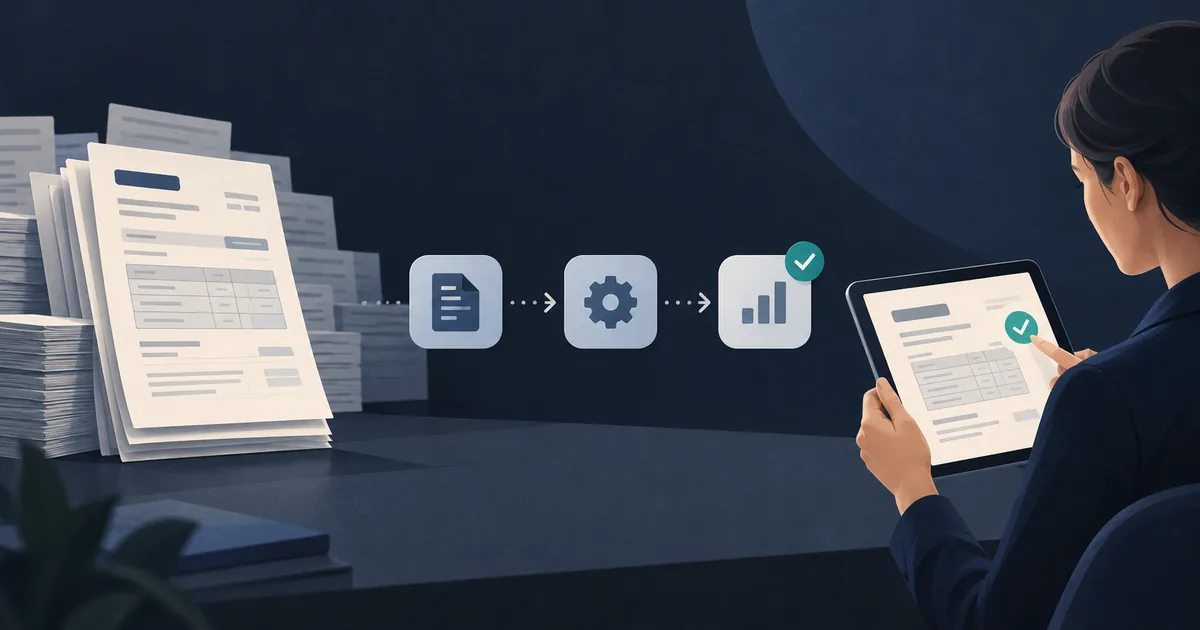
For invoices, that could mean filling in the supplier, amounts and dates automatically while leaving approval to the accountant. For email, the system could suggest a category and reply, with a person confirming the message before it is sent.
When to wait before automating
If the workflow changes every week, nobody can define a correct outcome or the input data is unreliable, automation may only make errors happen faster. Simplify and stabilise the process first. Then choose the technology.
Start with a small, frequent and measurable process. A good first automation removes routine work, makes the result visible and keeps a person in control wherever judgment is needed.
Have your own idea for an app, or a process you want to simplify?
We'll show you how we would build it.